
There are roughly 23 billion devices connected to the Internet of Things (IoT). By 2020, devices connected to the IoT are expected to explode beyond 50 billion. Connectivity puts an oyster at your fingertips. 13.8 billion years of accumulated knowledge in the palm of your hand. And humans are a curious bunch, aren’t we? Mathematics, literature, philosophy, travel etc. all driven by enquiry. Why should we assume people are any different today? They’re not. The fundamental differences are, to satisfy enquiry, we have access to better tools and more information. That’s it.
Every second, there are 40,000 searches conducted on Google. That extrapolates to 1.2 trillion annual searches worldwide. That oyster, it’s online. Mind you, this shouldn’t be particularly surprising. Real life public space observation should lead you to one conclusion; people appear to operate inside their one metre bubble, an immersive cocoon of touchscreens and mobile data. In Australia alone, there are an estimated 20 million mobile phones. Every day, 9 million Australians access Facebook with a mobile device and on average, Australians check their phone 14 times a day. What is it that we can’t seem to get enough of? You guessed it, content.
In its most simplistic form, consumers connect to the IoT for two main reasons; work or play. If we delve a little deeper, we broadly consume four main items on the IoT; information, entertainment, commerce, and interaction. As mentioned, broad categories but interestingly, all underpinned by commonality; content. When considering the Internet, Merriam-Webster defines content as “the principal substance offered by a World Wide Web site.” Understanding the definition of content is a great place to start when marketers launch Operation Bamboozle, a smorgasbord of everything connected to content marketing. More or less, content marketing is a strategic approach to creating and distributing relevant information to a specific audience that ultimately, drives profitable patronage. Essentially, you deliver information to empower prospective customers and over time, if done well, prospective customers become customers. Rather straightforward, so why then, has content marketing become so damn important?
Take a step back for a minute and ask yourself, what does my purchase process look like? Odds are, your purchase process diagram will look fairly similar to the large majority. Research suggests buyers guide themselves through 60-90% of the buyer journey, over 80% research online before making a major in-store purchase, and 67% say either reading or writing social media reviews and comments influences their online shopping behaviour. That suggests two things. 1. Buyers are more informed, and 2. Buyers are looking to become more informed. How do you inform buyers online? You create and distribute relevant information online to them.
First and foremost, it must be implicitly understood why brands need content marketing and a content marketing strategy (CMS). As the statistics demonstrate, consumers are already scouring the web for answers and if done well, content marketing will offer your brand three clear and measurable benefits. Firstly, during online information searches, if your brand continues to show up, naturally you can expect an increase in brand awareness. Secondly, if you offer solutions to the problems faced by prospective customers, your brand may be perceived as an industry thought leader. This may result in an increase in brand preference. Third and finally, think of content as an annuity. Content marketing isn’t a short-term strategy. You’re building an online library, one populated by great problem solving content. Keep in mind, it’s perfectly fine to plan seasonally (and you should). For financial services, specific dates on the business calendar will drive specific enquiries. Publish your content and simply refresh it to requirements of the time. Happy days. Over time, this approach should provide you with greater reach and a cost-effective outcome. That’ll keep the accountants happy.
To launch an effective content marketing strategy you need to think like a prospective consumer… then make everything as humanly easy as possible for them. In layman’s terms, that means you need to do almost all of the work for the prospective customer. The immediate goal of the content you provide should be to solve the prospective customer’s problem. That means internally, you need to ask a lot, and a lot, and a lot of questions, and you’ll need to develop robust marketing personas for each specific segment engaging with your brand. If you’re an established brand, you should already have a pretty good understanding of the drivers, pain points, key message items etc. for these audiences, however, if you don’t, or if you’re a start-up, you should develop these personas as soon as possible. Marketing without understanding your audience is akin to playing darts in the dark. You may hit the bullseye, but more than likely, it’ll be a lucky shot. To bastardize one of Bruce Lee’s famous lines “be like the consumer.”
To “be like the consumer” you’ll need to identify their knowledge level, the problem they are trying to solve, steps they may have already taken to solve the problem, the desired outcome of solving their problem (not the generic response you’ll most likely hear), and without being an outright sell, communicating how your product/service is the solution to their problem. Remember, never lose sight of the ultimate goal that your content marketing strategy should be designed to convert prospective customers into loyal customers and brand advocates. The skill is in building familiarity, trust, and patronage without directly appearing to ask for it. “Build it and they will come.”
You’re probably wondering, “what is it that I will be building?” Well, content comes in many different formats and can be delivered across multiple channels. At minimum, content formats you should consider include blog posts, enewsletters, cheatsheets (think quick bites of useful information), whitepapers, case studies, infographics, presentations, Q&A sessions, webinars, and audio/video broadcasts. Common delivery mediums may include Facebook, Google+, Instagram, LinkedIn, Pinterest, Snapchat, Twitter, YouTube, native websites, and email. This list is condensed but, if it’s connected to the IoT and if your demographic engages with it, consider it a potential delivery platform. Needless to say, social networking is one of the big players here so keep in mind consumption demographics for each channel. Oh, and make sure all of (and I do mean all of) the content you publish is shareable. Never be surprised by the power of a share/retweet/embed.
When conceiving your content marketing strategy, Search Engine Optimisation (SEO) should be one of the critical components you consider. You’re going to want to make a good impression with Google, YouTube, Bing etc. because your content, no matter how well written or how useful, will lose some of its worth if prospective consumers can’t find it. If a tree falls in the forrest, did the tree really fall? You’re going to need to make an indexation impression to shoot up the search engine rankings. However, fear not. Google is constantly updating its algorithms and as expected, high quality content is viewed favourably. As a bare minimum, consistently produce high quality content, content that not only solves problems for the market but content that search engines will favour. Immediate steps you can take toward search engine favourability include the strategic use of keywords (and associated triggers), including media in your posts or on landing pages, and developing mutually beneficial relationships with other industry authorities in an information-link share arrangement. A you scratch my back, I scratch your back agreement.
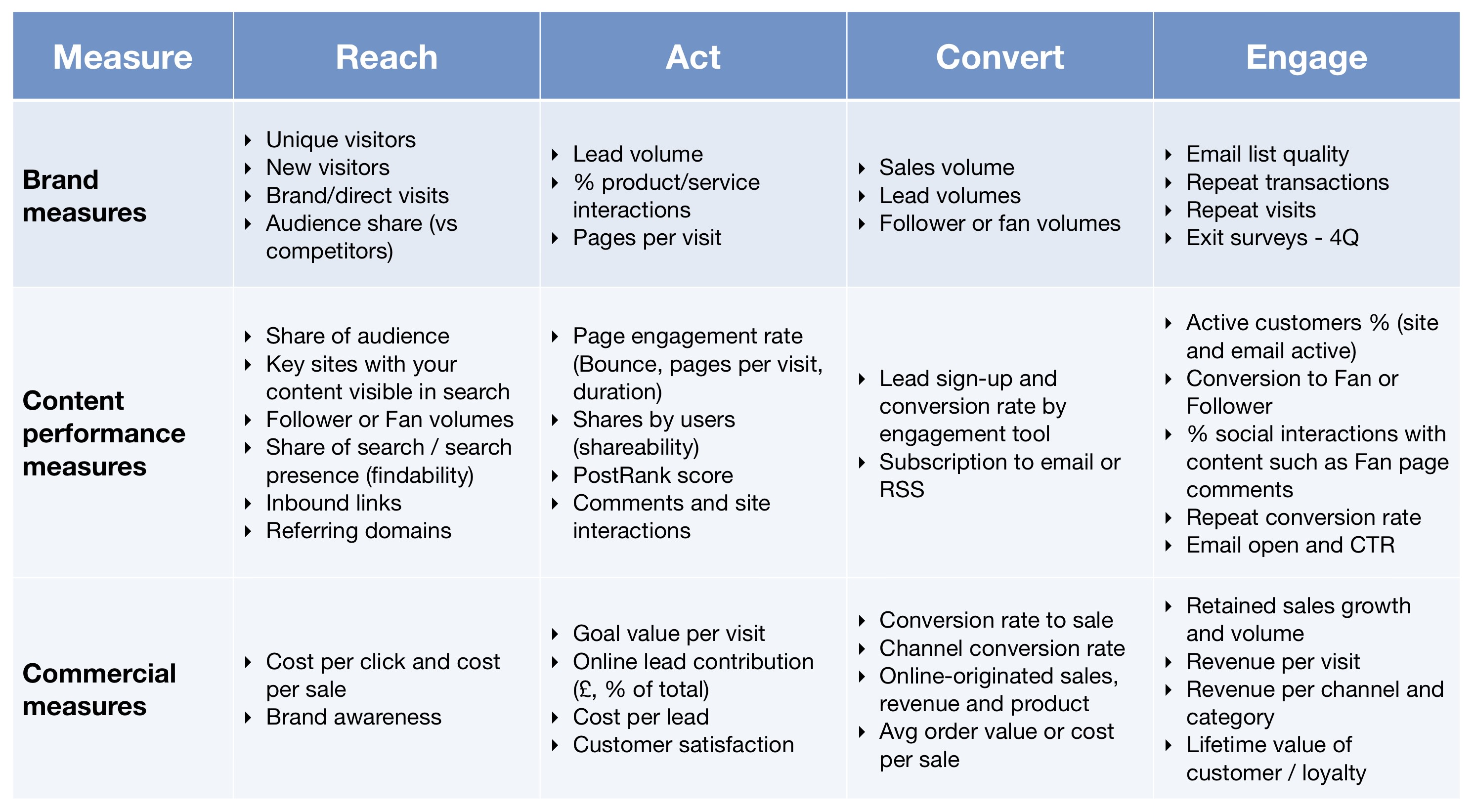
Lost in the hustle and bustle of the new-age digital stampede, your content marketing strategy, as described by the preeminent Phillip Kotler, remains rooted in the fundamental core concepts of marketing. Never forget that you are attempting to satisfy the needs/wants/demands of current and prospective customers. The point of departure comes in the form of focus as the customer becomes the central figure in the chain. It’s as if content marketing has become the poster child for the symbiosis of push-pull strategies. Moving back to the fundamental core concepts of marketing, what good is any strategy if you can’t measure its relative success or failure? You will need to identify relevant KPIs however, the recent explosion of big data and data analytics (keep an eye on the development of super-computers and quantum computing) makes your task a little easier. Online, there is almost nothing that cannot be measured. Google Analytics is a brilliant tool and the native analytics offered by social networking platforms have, in recent times, improved tremendously. Enterprise has grabbed the data bull by its horns (think Adobe Analytics, IBM Watson Analytics etc.) and run with it but keep in mind, all the data in the world is useless without first identifying the measurables and then tying them to results.
If you’re still reading, congratulations. You’ve just taken a crash course in content marketing. Now here’s one rather useful piece of information often overlooked by typical content marketing pieces. You can turn one piece of content into a great number of pieces of content, all designed for maximal impact on their chosen distribution channel. For instance, information from a webinar can be turned into a Facebook post, a LinkedIn post, a YouTube video, an Instagram post, a Snapchat recording, an audio recording, an infographic, an enewsletter article, a blog post, an email, an SMS, and so on. That’s 11 different distribution channels from the get-go, all with their own nuances and audiences. Now bring it back to the earlier raised topic of seasonality. Remember that Introduction to LRBA piece you wrote in 2014? It might be time for you to update it to today’s specifications but hey, the hard yards have already been done. Suddenly, you’ve got yourself a seasonal (which means repeatable) mini-campaign. Remember the annuity comment? Neat huh.
Content marketing is here, and it’s here to stay. Every day, the online global village expands with more and more members coming online. It’s not inconceivable to believe a Norwegian farmer browsing the web for a specific answer to a specific query may land on the site of an Australian farming supplier. The Norwegian farmer may not be within the Australian supplier’s persona sub-set, but the indexation of valuable information doesn’t care for that. The same problem in Norway is the same problem in Australia. That’s the power of connectivity. That’s the power of information. Ignore it at your peril.
TLDR CliffsNotes Version
Related Article(s)
Hajduk Consulting – 40 Tools to Conquer Digital

LEAVE YOUR COMMENT